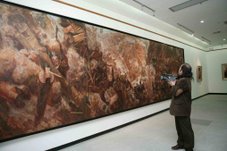
China's CCTV, the largest national television network in all of China, on June 27 this past week broadcast
a three-minute, fifteen-second review of Tu Zhiwei's exhibition of paintings at the National Museum of Fine Arts in Beijing. It is a superb television report, narrated (in English) by Robert Ireland.
An abbreviated four-page written entry (also in English) is available
here.
For Western viewers, the video is best seen using a fast connection and an up-to-date Internet Explorer browser with the latest Java plug-in. (CCTV tends to use the very latest in production and internet technology.) U.S. cable TV and satellite viewers may be able to catch a replay if their home TV provider includes the English-language "Culture Express" channel in the program lineup. (See, for example,
Direct TV's channel 455.)
Ireland first takes a look at some of the paintings from Tu's "bones" period. "The divided world of Tu Zhiwei," he perceptively calls it. It is a world, he reports, "that exists on many levels, divided vertically and horizontally, and even touching new dimensions."
Presumably the painter resides here somewhere. But just where, may be hard to cite, as he seems to set his spirit free from the confines of the body, entering a realm a little beyond immediate experience, a little removed from the known time-space continuum.
Tu's "bone" paintings were conceived in his earliest years in the U.S. when he was working alongside the late, revered American painter,
Jules Kirschenbaum. It was an exciting but scary time in the life of the artist. He found himself thrust into a completely foreign culture, far removed from family and friends, struggling with an alien language and adjusting to American ways that can seem exceedingly strange to an outsider. Yet, he was also suddenly free to dedicate every waking moment to his art.
"Many dimensions," indeed.
Turning to later works such as a number of nude portraits and Tibetan paintings included in the exhibition, the reviewer acutely observes that "viewers find it hard to connect" these works with the same artist who conceived the "bones" paintings.
Like his paintings, Tu the man, has many facets and styles. Visitors find it hard to connect the nude paintings hung on the opposite wall, to the creator of such startling imagery [as the "bones" paintings]. The thick, short strokes and hazy lines recall Impressionism. More precisely, it's an expression of the American variant, in which the figure retains more of its original form.
As for his latest work, "it's in these --
his history-themed giant canvasses -- that the painter's artistic genius comes into full force."
The compositional rigor, paired with splendid color sense, evoke such Western masters as Titian and Van Eyck.
* * *
These grandiose scenes, depicting events of great moment, probably would find their place as chapel pieces if such religious constructs were found in Chinese history. But the expressions of faces, ranging from panic and horror to outrage and despair, belie the artist's obsession with the darker side of history.
Indeed, if there's any altar for these works to be lain, it may be said they rest on the altar of the human spirit.
After what has to be described as a triumphant artist's tour of major Chinese museums, Tu returns to the United States this coming month. No doubt energized and inspired, he'll be resuming both his remarkable artistic work and his role as
'informal ambassador' building bridges across the Pacific for artists on both sides of the Pacific.