Thursday, March 20, 2008

Art Fraud

Patrick Fitzgerald, the highly respected U.S. Attorney for the Northern District of Illinois, announced yesterday the indictment of "seven defendants, including three Europeans and residents of Florida, New York and Illinois" for international art fraud:
Two separate indictments allege that the defendants sold thousands of counterfeit prints – at prices well in excess of their value – to victims in the United States, Canada, Australia, Europe and Japan. The indictments allege that the defendants together reaped more than $5 million in illegal proceeds from the separate, but overlapping fraud schemes. In both cases, investigators tracked the distribution of bogus works, purportedly by such artists as Pablo Picasso, Marc Chagall, Roy Lichtenstein, Joan Miro, Andy Warhol and others, from counterfeit distributors to an art dealer in north suburban Northbrook, who allegedly sold the inauthentic prints to victims, primarily through eBay, an internet auction web site.
Click here for a complete copy of the actual legal indictment.

Both casual buyers and professional art collectors are easy marks for art frauds. Your best protection is to buy contemporary art direct from the artist and legacy art from reputable galleries and dealers. If that "master" print on Ebay looks too good to be true, chances are it is a fake.

Wednesday, February 13, 2008

Shanghai Art Show Photos

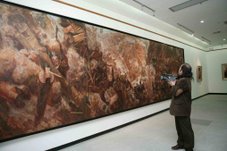
Snapshots taken during the Tu Zhiwei art exhibition at the Liu Hai Su Museum in Shanghai have appeared on the Tu Zhiwei Art Gallery web site.

Thursday, January 10, 2008

Tu Zhiwei's Shanghai Show

Tu Zhiwei's show at the Liu Haisu Art Museum in Shanghai, China has opened. Today, Wang Jie has an interesting review/article in the Shanghai Daily. A link to the original and a mirror reproduction of the article can be found here.

Monday, December 3, 2007

Shanghai Show for Tu Zhiwei

The new Liu Hai Su Art Museum will be staging a one-man show of Chinese-American oil painter Tu Zhiwei's works January 6-16, 2008. Get the details here as they become available.

Thursday, September 27, 2007

OPA Midwest Regional

Zhiwei Tu has an entry in the Midwestern Regional Exhibition of the Oil Painters of America, which runs from September 30 to November 30. A photo of his painting (see above) and a link to the Topeka, Kansas, gallery hosting the event can be found on the Tu Art Gallery web site.

Informal photos of the August opening of his one-man show at the Andreeva Gallery in Santa Fe also can be viewed here. It's fun to see Mr. Tu's talented wife, who made an impromptu appearance with the strong quartet hired for the event.

Saturday, September 1, 2007

Santa Fe One-Man Show

We've mentioned before that Santa Fe's Andreeva Portrait Gallery is currently sponsoring a one-man exhibition of works by Zhiwei Tu. The latest issue of Art of the West carries a full page ad promoting the show. Click the image above for a closeup view.

Saturday, August 25, 2007

Taos Art Auction

Tonight, collectors of oil paintings by Zhiwei Tu will have an opportunity to buy one of his more recent oil paintings, shown above, at the "3rd Annual Gala Auction" in Taos, N.M. Possibly for a song (pardon the pun). Certainly for a good cause.

Click here for a preview of all the art works and crafts up for auction. Apparently, telephone bids may be accepted:
If you are interested in placing a bid or would like more information on an item, please call 505.758.2690 x 5.
The auction will benefit the Taos Art Museum and Fechin House, located in the former home of Russian emigré artist Nicolai Fechin. (1881-1955). Fechin is said to have designed and hand-carved many of the features of the house, which was finished in 1933.

Tuesday, August 21, 2007

Zhiwei Tu's China Live Webcast

Look what just popped up on the Internet: a one hour on-line video of a live webcast with Zhiwei Tu, produced by Tom.com this past June.

One hour!!


The event was held in connection with Mr. Tu's one-man show at the National Art Museum of China. Tom.com is a "mobile internet company" specializing in web-casting (as opposed to more traditional "broadcasting") to a wide audience throughout China.

The program, naturally, is in Chinese. Just as happens with regular TV, a studio host interviewed Mr. Tu about the NAMOC show, his early years in a remote farming village when he was discovered to be a prodigy at painting, and his move to the U.S.A. to further his art education. What's so different with this "webcast" is that there was ample time to explore additional subjects and take live questions from viewers, apparently sent in by email or text-messaging.

Among the many subjects covered are the differences between art education in China and the U.S., the practicalities of how newly arrived Chinese artists can get by in the West, the inspiration Mr. Tu drew from his artistic mentor in the U.S., etc. etc. Several viewers apparently wanted to know more about the Oil Painters of America, a relatively new but very effective organization of artists (with affiliates in Canada and Mexico) that has helped to introduce the art work of many domestic and newly-arrived foreign artists to a Western audience.

Shorter excerpts of the interview can be viewed on the Tu Zhiwei Art Gallery web site here. For non-Chinese speakers, English summaries are provided.

Of the excerpts available, our favorite is "The Artistic Passion of Tu Zhiwei: Ten Epic Murals in Ten Years." It runs a little over six minutes. In this segment, Mr. Tu discloses that the five giant murals he's completed are just half of the ten he plans to do before "I rest in peace." One of them, he explains, is about Confucious.

Take a look at the first five murals and you can see why so many people are excited at what is yet to come from this extraordinary artistic genius.

Thursday, August 16, 2007

Santa Fe Exhibition Opens

Today is the opening for Zhiwei Tu's exhibition at the Andreeva Gallery in Santa Fe, N.M.

The gallery's on-line display includes thirteen portraits from his Ballerina and Tibet portrait series. One of them is pictured above: "Dancer Reading."

Friday, August 10, 2007

The latest Art of the West issue includes a full page ad for Zhiwei Tu's upcoming one-man show at Andreeva Gallery i n Taos, N.M. The show begins August 16-Sept. 20, 2007.

More info coming soon.

Friday, August 3, 2007

Zhiwei Tu's Native American Portraits

"Ghost Dancer"

There's a new section up on the Tu Zhiwei Art Gallery web site. It's called "Native American Portraits."

These particular paintings, we understand, currently are being shown at the Nichols Gallery in Taos. They're part of a larger, ongoing series Mr. Tu has been doing, inspired by his first encounter with Sioux Indians when he vacationed in South Dakota shortly after emigrating to the United States and his later investigations of other tribes in the Western states.

All of the portraits are stunning, especially when viewed in person. Our personal favorite, though, is shown above -- "Ghost Dancer." It captures perfectly the slightly crazed, obsessed, and yet euphoric sentiment one can easily imagine in the hearts of many desperate Native Americans who joined this religious revival movement in the late 19th century as the white man overwhelmed their way of life.

Thursday, August 2, 2007

New Landscape for Baiyun Center

Baiyun International Convention Center

Radio Guangdong, the first English-language radio station in that south China province, reported early last month that a large landscape by Tu Zhiwei is scheduled to be hung in Shaoguan Hall inside the new Guangzhou Baiyun International Convention and Exhibition Center. The center, which for the moment is believed to be the second-largest convention center in the world, consists of five buildings built in phases over several years.

The latest reports are that the entire complex is nearing completion, although the main hall has been in use for several months, now. Dan from the Philippines has posted a few photos of the center on his "Reverse Entropy" blog.

Mr. Tu's mural, titled "Light on Dan Xia Mountain," measures nearly 9 x 15 feet. To the left is a button of the mural, but such a small image can't do it justice.

A larger, far more dramatic digital photograph of the painting can be seen on the Tu Art Gallery web site, here. Formal unveiling of the painting is expected some time later this year.

Dan Xia Mountain is located in the world-famous redstone park near Tu Zhiwei's home village in Liu-Li Township. The area also is a popular honeymoon get-away, no doubt inspired by the giggles-inducing nearby site of "Yangyuan Stone" (aka "Father Rock") and "Yinyuan Hole."

Thursday, July 26, 2007

Art on Your Cell Phone

Recent news reports claim that more and more Americans are surfing the web with their cell phones and PDA's. It's hard to believe. The screens are so small and the data most cell phones can handle is severely limited. Not for nothing does one popular TV ad show a hapless cell phone user asking, "Can you hear me now?"

We'll believe surfing the 'Net with cell phones is a promising trend when our own phone can handle telephone calls inside a department store.

Added to that, so we've read, the sundry cell phone manufacturers are no closer to agreeing on a uniform method for rendering web sites than they are on a compatible technology for making telephone calls. The result is not every cell phone can show a "mobile" page in the same way. Some can't do it at all.

Still, the New York Times reported earlier this year cell phone web-surfing is all the rage in the Far East. And it looks like it's coming our way:
It sounds like something straight out of a futuristic film: House hunters, driving past a for-sale sign, stop and point their cellphone at the sign. With a click, their cellphone screen displays the asking price, the number of bedrooms and baths and lots of other details about the house.

Media experts say that cellphones, the Swiss Army knives of technology, are quickly heading in this direction. New technology, already in use in parts of Asia but still in development in the United States, allows the phones to connect everyday objects with the Internet.

In their new incarnation, cellphones become a sort of digital remote control, as one CBS executive put it. With a wave, the phone can read encoded information on everyday objects and translate that into videos, pictures or text files on its screen.

“The cellphone is the natural tool to combine the physical world with the digital world,” that executive, Cyriac Roeding, the head of mobile-phone applications for CBS, said the other day.

In Japan, McDonald’s customers can already point their cellphones at the wrapping on their hamburgers and get nutrition information on their screens. Users there can also point their phones at magazine ads to receive insurance quotes, and board airplanes using their phones rather than paper tickets. And film promoters can send their movie trailers from billboards.

Undoubtedly, instant surfing with a cell phone has its conveniences (when it works). But no one knows if artists, galleries, and museums -- or others with interests centered on the visual arts -- are likely to find them compelling.

Nevertheless, friends of Tu Zhiwei have decided to experiment by dipping a little toe into these murky cellular waters. On the News section of the Tu Art Gallery web site, there's a new hyperlink called "Tu Art News for Mobile Devices." It takes readers to a proto-site titled "Tu Zhiwei Art Mobile."

The "mobile" site is slimmed-down -- downright skinny, in fact -- with only three pages (or "cards" as they are known) and just 15 lines of text and four images, in total. They look fine to computer users. It's anyone's guess how they appear on each of the several thousand different cell phones in use around the world.

The idea behind the "mobile" web site experiment is that PDA and cell phone users may find it convenient at times to surf for calendar or contact information about upcoming art gallery shows. In this instance, what's being offered is, first, hard information about Mr. Tu's next one-man show, scheduled to open at the Andreeva Gallery in Santa Fe on August 16.

Second, they can see a few tiny images of recent shows of Mr. Tu's paintings in Guangzhou, Shaoguan, and Beijing.

Third, cell phone users can use a link on the "mobile" web site to navigate to Andreeva Gallery's own web site and even fire off an email message.

Some new ideas are better than others. This one -- using cell phones to view art -- will take time to mature, at the very best. In the meantime, though, we plan to have fun watching how the experiment turns out.

Tuesday, July 24, 2007

Call for Help

Two new sections have been added to the Tu Art Gallery web site. One of them includes a general call for help.

"Reviews of Art, Shows, and Exhibitions" reprints a number of newspaper reviews, articles, art book introductions, and television reports about Tu Zhiwei's oil paintings. Some go back as far as 1996.

We know there are a lot more out there, in English, Mandarin, French, Dutch, Russian, and Arabic, for starters. So, on the Tu Art Gallery web site, readers are being asked to send along any reviews or commentaries they may know about:
We have begun compiling here newspaper, magazine, television, and book reviews about the art works of Tu Zhiwei, as we learn of them. If you know of any not included here, please let us know.)
The problem is that many older art show newspaper reviews, descriptive brochures, and the like were published before the Internet was invented, never made it to the web, or are buried too deep (for example, in an unfamiliar foreign language) to be easily discovered.

Probably the most difficult material to find will be notices from foreign art shows of Tu's work from the 1980's and early 1990's -- such as the earliest exhibitions in Guangzhou, the Algiers "World Cultural Convention" in 1987 when he was awarded the "gold prize", or his first gallery shows in Iowa, Illinois, Minnesota, Kansas, and Michigan.

We know there are a lot of other newspaper and magazine reviews out there -- especially from the artist's earlier days in China (1972-1986) and after he emigrated to the U.S. in 1987. If you happen to have a hard copy, please scan and email it. If you know of something suitable on the web, just send along the url.

The same might be said about the other new web section. It's called "Lectures, Installations, and Happenings."

Tu Zhiwei is an active volunteer (consistent with his busy international schedule) for community art organizations. He also often participates in painting demonstrations or college lectures for art students, and from time to time engages in other entertaining 'happenings' like group art installations.

A few past events of this order already have been noted on the web site's 'Happenings' page. Again, however, we're sure there are many more that we haven't discovered, yet, either on the Internet or described in dead tree print.

The artist himself is too busy doing all of these things to do any 'scrapbooking' of his own. We can all help him out -- not to mention, assist future biographers -- by playing catch-up now.

Monday, July 16, 2007

Time Traveler

China Daily's review of the recent exhibition of paintings by Zhiwei Tu at the National Museum of Art in Beijing is now on-line. The title of the piece is "Time Traveler."

Here is a snippet:
Looking at any of his colossal, epic oils full of action and drama, the viewer would be deeply affected by the well-calculated composition and infectious ambience Tu has poured out with passion on the canvases," comments Shao Dazhen, a renowned art critic and professor with Central Academy of Fine Arts in Beijing.

"Imbued with brilliant expression of emotions, Tu's masterful depiction of the chapters of Chinese history are so arresting to the viewers thanks to the lush colors, dazzling lights, alluring imageries, and astonishing details," Shao says.
You can read the entire review in the original (English) version here, or on the Zhiwei Tu Art Gallery.com site here, along with other recent news about the artist.

Saturday, July 14, 2007

Santa Fe One-Man Show

Just back from a hugely successful two month sojourn in China, Zhiwei Tu now has to prepare for a one-man art show at the Andreeva Gallery in Santa Fe, New Mexico. Click here for more information.

Monday, July 2, 2007

Video of The Beijing Exhibition Review

Video of the CCTV Channel 9 review of Tu Zhiwei's one-man show at the National Art Museum of China is now available. Watch and enjoy:

Saturday, June 30, 2007

China TV Covers Tu Exhibition

China's CCTV, the largest national television network in all of China, on June 27 this past week broadcast a three-minute, fifteen-second review of Tu Zhiwei's exhibition of paintings at the National Museum of Fine Arts in Beijing. It is a superb television report, narrated (in English) by Robert Ireland.

An abbreviated four-page written entry (also in English) is available here.

For Western viewers, the video is best seen using a fast connection and an up-to-date Internet Explorer browser with the latest Java plug-in. (CCTV tends to use the very latest in production and internet technology.) U.S. cable TV and satellite viewers may be able to catch a replay if their home TV provider includes the English-language "Culture Express" channel in the program lineup. (See, for example, Direct TV's channel 455.)

Ireland first takes a look at some of the paintings from Tu's "bones" period. "The divided world of Tu Zhiwei," he perceptively calls it. It is a world, he reports, "that exists on many levels, divided vertically and horizontally, and even touching new dimensions."
Presumably the painter resides here somewhere. But just where, may be hard to cite, as he seems to set his spirit free from the confines of the body, entering a realm a little beyond immediate experience, a little removed from the known time-space continuum.
Tu's "bone" paintings were conceived in his earliest years in the U.S. when he was working alongside the late, revered American painter, Jules Kirschenbaum. It was an exciting but scary time in the life of the artist. He found himself thrust into a completely foreign culture, far removed from family and friends, struggling with an alien language and adjusting to American ways that can seem exceedingly strange to an outsider. Yet, he was also suddenly free to dedicate every waking moment to his art.

"Many dimensions," indeed.

Turning to later works such as a number of nude portraits and Tibetan paintings included in the exhibition, the reviewer acutely observes that "viewers find it hard to connect" these works with the same artist who conceived the "bones" paintings.
Like his paintings, Tu the man, has many facets and styles. Visitors find it hard to connect the nude paintings hung on the opposite wall, to the creator of such startling imagery [as the "bones" paintings]. The thick, short strokes and hazy lines recall Impressionism. More precisely, it's an expression of the American variant, in which the figure retains more of its original form.
As for his latest work, "it's in these -- his history-themed giant canvasses -- that the painter's artistic genius comes into full force."
The compositional rigor, paired with splendid color sense, evoke such Western masters as Titian and Van Eyck.
* * *
These grandiose scenes, depicting events of great moment, probably would find their place as chapel pieces if such religious constructs were found in Chinese history. But the expressions of faces, ranging from panic and horror to outrage and despair, belie the artist's obsession with the darker side of history.

Indeed, if there's any altar for these works to be lain, it may be said they rest on the altar of the human spirit.
After what has to be described as a triumphant artist's tour of major Chinese museums, Tu returns to the United States this coming month. No doubt energized and inspired, he'll be resuming both his remarkable artistic work and his role as 'informal ambassador' building bridges across the Pacific for artists on both sides of the Pacific.

Friday, June 15, 2007

Beijing Exhibition Opens

Tu Zhiwei's exhibition at the National Art Museum of China opened today. It is really quite an honor for the artist. In a nation of 1.4 billion, a one-man show at NAMOC in Beijing is the equivalent of the same at the Metropolitan Museum of Art and the Hirschhorn, combined.

Tuesday, May 22, 2007

Shenzhen Art Exhibition

Photos of the one-man exhibition of Tu Zhiwei's works at the Shenzhen (China) Art Museum have arrived. They're now being featured on Zhiwei Tu's web site here.

The museum's description of the show, in Chinese, is mirrored here.